

This article contains promotions
Have you ever stared blankly at your smartphone screen while swaying on the last train, sighing and wondering, “Will I be okay living on just my current company salary 10 years from now?”
Back when I worked at a trading company until late every night, I felt the exact same vague anxiety about my future finances.
While searching for ways to increase my assets even with little capital or spare time, many people eventually hear about a trading method called “FX scalping.”
Hearing that “you can finish a trade in a few seconds to a few minutes, so you can do it in the short time after work,” it might seem like a very attractive option for busy office workers.
However, once you start looking into it, you will likely find yourself overwhelmed by technical jargon, making many people hesitate and wonder, “How do I actually trade?” or “Can a beginner really do this without losing money?”
In this article, I will break down and explain everything from the basic definition of what FX scalping is, its differences from day trading and swing trading, its pros and cons, to the specific methods and risk management calculation methods that beginners should know.
I will share not only the good aspects but also the harsh realities and cost structures you should know in advance, so please use this as a basis to calmly judge whether this method suits your own lifestyle and personality.
What is FX Scalping? An Easy-to-Understand Explanation of the Definition and Basics of Holding Time
Scalping in FX refers to an ultra-short-term trading method where you complete the buying and selling of currencies in an extremely short holding time of a few seconds to a few minutes, accumulating small profits repeatedly.
The English word “scalp,” which is the etymology, means “to peel off a thin layer of skin from the head,” and the name stuck because of the nuance of “quickly peeling off and accumulating thin profits from the market.”
In FX trading, the smallest unit of price movement is expressed by a common unit called “pips.”
For currency pairs involving the Japanese yen, such as the US dollar/yen, 1 pip is equivalent to “0.01 yen (1 sen).”
There is no legal definition for scalping, but generally, the basic style is to aim for a very small profit margin of “a few pips to about 10 pips (a price movement of about 0.03 yen to 0.10 yen)” per trade, repeating the buying and selling dozens of times a day, or over 100 times for some people.
For example, it is easy to understand if you imagine a store mechanism that repeats the work of selling one juice from a vending machine to earn a few yen in profit dozens of times at high speed.
Even if the profit per trade is small, the basic structure of FX scalping is to aim for total profit by repeating the number of trades.
What is the difference between stock and FX scalping?
While the scalping method is also used in stock investment, there are major differences in trading hours and capital efficiency between stocks and FX.
Since the Japanese stock market is generally only open during the day on weekdays (9:00 to 15:30), it is difficult for office workers who have a full-time job during the day to perform scalping with stocks.
On the other hand, FX (Foreign Exchange Margin Trading) allows trading almost 24 hours a day on weekdays because markets around the world open like a relay.
Furthermore, while domestic individual FX accounts allow for a maximum leverage of 25 times (4% margin rate) due to regulations based on the Financial Instruments and Exchange Act, leverage for stock margin trading is limited to approximately 3.3 times (30% deposit rate, with a minimum deposit of 300,000 yen or more).
Therefore, there is a clear difference between stock and FX scalping in terms of being able to trade at night after work and being able to trade with high capital efficiency from a small amount of initial capital.
Comparing the Differences Between FX Scalping, Day Trading, and Swing Trading

FX trading methods are broadly classified into three types based on the duration for which you hold a position (the currency you are holding): “Scalping“, “Day Trading“, and “Swing Trading“.
When beginners are unsure whether to choose scalping or day trading, it is helpful to compare them by using track and field events as an analogy to clearly organize the differences.
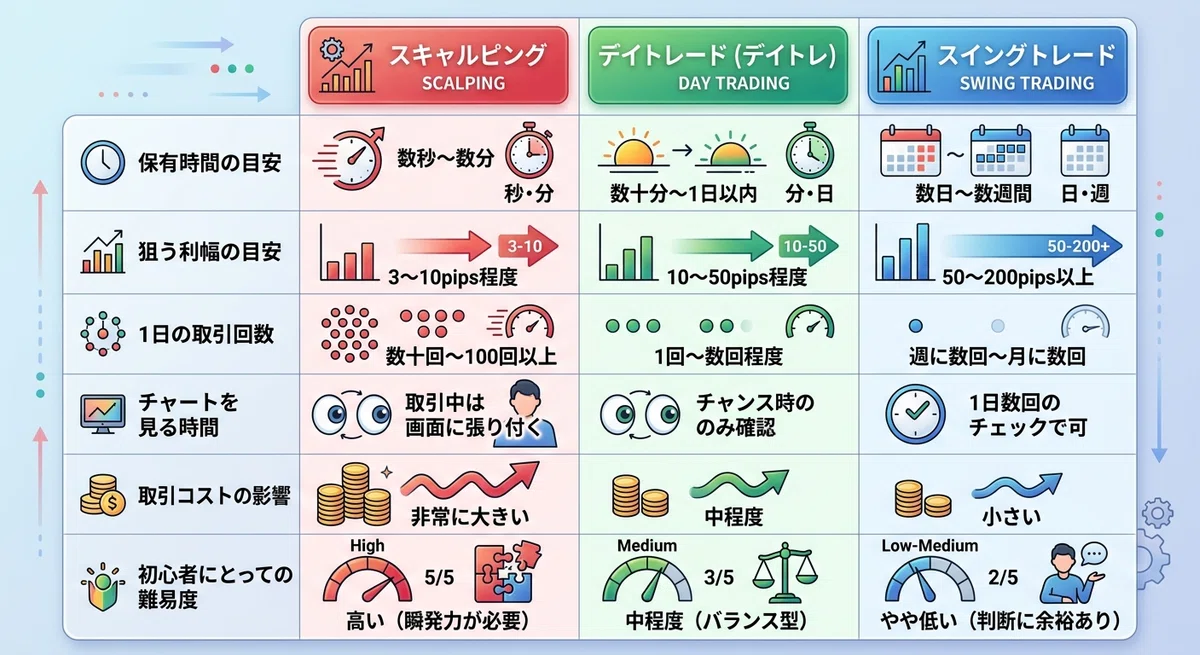
If scalping is a sprint event where you run at full speed repeatedly, day trading is like a middle-distance race where you reach the goal within the day while considering your pace, and swing trading is like a long-distance marathon where you run steadily over several days.
Which is better for beginners: scalping or day trading?
In conclusion, for FX beginners who are not yet accustomed to reading charts or operating orders, day trading or swing trading tends to be easier to judge calmly than scalping.
This is because in scalping, you must continuously decide whether to “buy, sell, or cut losses” in a matter of seconds, and the market may move against you while you are hesitating.
On the other hand, if you have a clear purpose such as “I am busy with work during the day and only want to focus on trading for a fixed 30 minutes to 1 hour at night” or “I want to avoid holding losses due to sudden market changes while I am sleeping,” then scalping or short-term day trading become options.
However, if you narrow your perspective to only one method, such as ultra-short-term FX trading, you are more likely to become discouraged if it does not suit your personality or lifestyle rhythm.
If you are wondering what kind of side job or asset formation is right for you in the first place, one option is to first take a look at an environment where you can compare a wide range of options for free.
For those trying a side job for the first time, those who have given up in the past because it was too difficult, or those who are tired of being swayed by suspicious information. Zero-Aca is a side job course where you can learn practical know-how ranging from blog x AI utilization, reselling, and investment from the basics for free, without technical jargon. Just by registering and adding a friend via QR code from your smartphone, you can check at your own pace whether it is a learning method that suits you.
→ Take a look at the free Zero-Aca side job LINE course
Three Benefits of FX Scalping

Although FX scalping is often described as having a high level of difficulty, there is a clear reason why many traders choose this method.
Here, let’s look at the representative benefits unique to scalping, divided into three points.
1. Short holding time allows you to avoid the “risk of sudden changes while sleeping”
The foreign exchange market can move significantly even in the middle of the night or early morning while we are sleeping, due to statements by overseas dignitaries or sudden news.
In the case of swing trading, where you carry positions over to the next day, it is possible that you could wake up in the morning to find that an unexpected crash has occurred and you are holding a large unrealized loss.
In that respect, the iron rule of scalping is to always complete settlement in a few seconds to a few minutes, and to hold no positions (be in a no-position state) when you finish trading and close your computer.
Because the holding time is extremely short, you are not exposed to the risk of sudden market fluctuations during hours when you are not trading, offering the mental benefit of being able to sleep at night without worrying about the market.
2. Completes in short bursts of concentration, making it easier to increase capital efficiency
The second benefit is that you can rotate your available capital efficiently.
For example, when holding 10,000 currency units (equivalent to 1.5 million yen if 1 dollar = 150 yen), the minimum required margin for a domestic retail FX account (maximum leverage of 25x, required margin rate of 4%) is calculated using the following formula.
$$\text{Required Margin} = 150\text{ yen} \times 10,000\text{ units} \times 4% = 60,000\text{ yen}$$
In swing trading, this margin remains tied up for the several days it takes for a single trade to conclude.
However, with scalping, you can settle in a few minutes to release the capital and repeatedly invest it into the next opportunity within the same day.
Also, being able to set aside specific times, such as just one hour at night when price movements are active, is one of the attractions for company employees.
3. High frequency of trades makes it easier to accumulate experience in a short period
The third benefit is that the verification cycle for trading is overwhelmingly fast.
With a strategy that only trades once a week, it takes about two years to gain 100 trades worth of experience.
On the other hand, with scalping, it is not rare to perform 10 to 20 trades a day, so it has the characteristic of making it easy to repeatedly practice practical senses such as chart price movement habits and order timing in a short period.
Disadvantages of FX Scalping and Risks Beginners Should Know

Behind the benefits, there are always disadvantages and risks.
In particular, scalping has many points where beginners are likely to stumble due to structural costs and rules, so let’s confirm while calculating using concrete numbers.
1. The burden of spreads (actual trading costs) accumulates
In FX trading, there is a slight difference between the price when buying a currency (Ask) and the price when selling it (Bid), which is called a “spread.”
The spread is an actual cost borne by the investor every time a trade is made.
For example, let’s calculate the case of performing a 10,000 currency unit trade in an FX account where the USD/JPY spread is “0.2 pips (0.002 yen).”
The spread cost per trade is $0.002\text{ yen} \times 10,000\text{ units} = 20\text{ yen}$.
You might think, “I wouldn’t care about just 20 yen,” but if you calculate the cost of making 50 trades a day with scalping and continuing that for 20 days a month (1,000 trades per month), it looks like this:
$$\text{Monthly spread cost} = 20\text{ yen} \times 50\text{ trades} \times 20\text{ days} = 20,000\text{ yen}$$
If you aim for a profit of 5 pips (0.05 yen = 500 yen per 10,000 currency units) per trade, a spread of 0.2 pips (20 yen) is equivalent to 4% of your profit.
The biggest disadvantage of scalping is that as the number of trades increases, these small costs add up and take a toll like a body blow.
2. Risk of loss expansion due to “slow and steady, then boom”
The failure pattern that beginners are most prone to in scalping is a phenomenon commonly known as “slow and steady, then boom.”
This refers to a situation where, despite steadily accumulating 10 profits of 3 pips (300 yen per 10,000 currency units) to reach a gain of 3,000 yen, when the market moves against you on the 11th trade, you hesitate to cut your losses thinking, “It might come back if I wait a little longer,” and end up blowing away all your profits with a single loss of 30 pips (3,000 yen) or more.
Furthermore, the Financial Services Agency has clearly warned that if the market fluctuates sharply in a matter of seconds due to the announcement of economic indicators or remarks by key figures, there is a risk that even if the FX company’s stop-loss rules are applied, the trade will not be executed at the expected price, resulting in losses exceeding the deposited margin.
3. Scalping is prohibited or restricted depending on the FX account
An unexpectedly unknown point to note is the fact that not all FX companies welcome scalping.
Trading that repeats a large number of orders in a matter of seconds can place a heavy load on the FX company’s servers or cause the cover trades (risk hedging trades with other financial institutions) that the FX company performs in the background to fall behind.
Therefore, if you perform scalping at a firm that prohibits “excessive continuous trading in a short period of time” in its terms of service, there is a risk that your account will be frozen or your trading will be restricted.
As described, because ultra-short-term FX trading requires advanced judgment and strict rule management, many people feel that “it seems a bit too high a hurdle for me.”
If you feel you would like to know about side jobs or asset formation options that you can proceed with at your own pace, not just FX, please try broadening your horizons and utilizing a place where you can learn from the basics.
For those who say, “I tried a side job in the past, but it was too difficult and didn’t lead to results,” or “I don’t want to be deceived by suspicious products, so I want to check the content for free first.”
At Zero-Aca, we publish free, step-by-step side job know-how that is hard for beginners to stumble over, ranging from basic investment knowledge to blog x AI utilization and reselling.
Just by registering and adding us on LINE via the QR code on the page, you can carefully compare and check the methods that suit you without overexertion.
→ Check basic know-how with the free Zero-Aca side job LINE course
For beginners! Basic methods and 5 steps for FX scalping

Even so, for those who say, “I want to understand the mechanism of scalping at a practical level” or “I want to try it with a small amount while following the rules,” we have organized the 5 specific steps that beginners should take, along with concrete figures.
-
Choose a domestic FX account that is registered with the Financial Services Agency and is “officially approved for scalping”
First, as a major premise, choose an account from among domestic FX companies registered under Japan’s Financial Instruments and Exchange Act that allows (or does not restrict) scalping on their official website, etc.
At the same time, choosing an account with the narrowest possible trading costs, such as a USD/JPY spread of 0.2 sen or less (generally fixed, with exceptions), is the first step to cost reduction.
-
Focus on major currency pairs with high trading volume (USD/JPY or EUR/USD)
Minor currency pairs are not suitable for scalping because they have high ‘liquidity risk’—meaning you cannot buy or sell when you want to—and wider spreads.
At first, focus on just one pair—either ‘USD/JPY’ or ‘EUR/USD’—as they have the highest trading volume in the world, relatively straightforward price movements, and narrow spreads, and observe their price action.
-
Target time zones when price movements become active (around 9:00 PM to 2:00 AM JST)
Although the foreign exchange market moves 24 hours a day, not every time zone is suitable for scalping.
Among the Tokyo market (approx. 9:00 AM to 3:00 PM), London market (approx. 4:00 PM to 1:00 AM), and New York market (approx. 9:00 PM to 6:00 AM, varying by season), the period when the London and New York markets overlap—’9:00 PM to 2:00 AM’ Japan time—has the most participants and is the primary battlefield for scalping because short-term trends are more likely to occur.
However, it is a golden rule to refrain from trading for 30 minutes before and after the announcement of important economic indicators, such as the U.S. employment statistics, because spreads widen sharply and prices fluctuate wildly.
-
Keep trading units to ‘1,000 currency units’ and start with an effective leverage of 3x or less
If a beginner starts trading with 10,000 units or more, a slight price movement will cause a profit or loss of several thousand yen, making it impossible to make calm decisions.
First, deposit 100,000 yen in funds and start with the minimum unit of ‘1,000 currency units’ (if 1 dollar = 150 yen, this is equivalent to a trading amount of 150,000 yen, with an effective leverage of 1.5x).
With 1,000 units, the profit or loss when the price moves 5 pips (0.05 yen) is 0.05 yen * 1,000 units = 50 yen, allowing you to practice operations and observe price movements while keeping mental stress to a minimum.
-
Always set a ‘stop-loss order’ at minus 3 to 5 pips at the same time as your order
The best defensive measure to protect your funds in scalping is to place a stop-loss order that automatically cuts losses at the same time you enter (new order).
For example, fix your ‘profit target at plus 5 pips and stop-loss line at minus 3 to 5 pips’ in advance, and strictly limit the maximum loss per trade to within 1% of your funds.
For the next month, try keeping a record of 30 trades using demo trading or small-lot trading of 1,000 units to verify whether you can execute your stop-loss rules without breaking them even once.
Characteristics of people who are suited and not suited for FX scalping

Based on the characteristics discussed so far, it is clear that there is a distinct ‘suitability’ for FX scalping.
First, those who are suited for scalping have the following characteristics:
-
People who can close positions mechanically according to their set stop-loss rules (minus a few pips) without letting emotions interfere.
-
People who have an environment where they can concentrate solely on the chart screen for 30 minutes to 1 hour a day without being disturbed by those around them.
-
People who can continue repetitive tasks and review their records calmly without being swayed by individual wins or losses
Conversely, those who fit the following characteristics are highly likely to lose capital through scalping and should not force themselves to try it.
-
People who pray that a position will recover when they see an unrealized loss, and end up postponing stop-loss orders
-
People who become emotional immediately after a loss and increase their trade volume (lots) to try and win it back right away
-
People who want to trade casually while multitasking, such as glancing at their smartphone between work or household chores
If you feel that you fit the latter even slightly, it does not mean your ability is low; it simply means that “scalping, a type of trading that competes in seconds,” does not suit your temperament.
For asset building or side hustles, there are various approaches, such as long-term asset management conducted over a relaxed timeframe, or blogging and utilizing AI to turn knowledge and effort into assets with almost no initial cost.
Frequently Asked Questions (FAQ) about FX Scalping

Finally, we will answer questions often received from beginners considering FX scalping, based on objective facts.
Q1. Can I do FX scalping with just a smartphone?
While it is possible to place orders using a smartphone app, there are situations in scalping where you will be at a disadvantage compared to a computer environment.
This is because scalping requires you to place orders with sub-second timing while simultaneously comparing charts with short timeframes, such as 1-minute or 5-minute charts, with the trends of higher timeframes (15-minute or 1-hour charts).
It is difficult to display multiple charts simultaneously on a small smartphone screen, and slight delays due to communication environments can lead to discrepancies in execution prices (slippage), so it is desirable to prepare a computer and a stable fiber-optic connection if you are going to engage in it seriously.
Q2. How much starting capital (initial funds) do I need to begin?
If you use an account at a domestic FX company that supports trading in 1,000 currency units, trading itself is possible with a minimum required margin of approximately 6,000 yen when 1 dollar = 150 yen ($150 yen * 1,000 units * 4%).
However, if you only have the bare minimum margin, even a slight move against your position will lower your margin maintenance ratio, leading to a forced liquidation.
Even when practicing with 1,000 units, it is realistic to start with a surplus of 50,000 to 100,000 yen in your account to provide a buffer and keep your effective leverage low.
Q3. Is there tax on profits earned from scalping?
Yes, whether it is scalping or day trading, taxes apply to the annual profits earned from FX trading (income after deducting necessary expenses from exchange gains and swap points).
Profits earned from registered FX dealers based on the domestic Financial Instruments and Exchange Act are subject to separate self-assessment taxation as “miscellaneous income related to futures trading,” and a total tax rate of 20.315% is applied, consisting of 15% income tax, 0.315% special reconstruction income tax, and 5% inhabitant tax.
For company employees with salary income, if income other than salary exceeds 200,000 yen per year, a tax return is generally required. Even if it is 200,000 yen or less, there are cases where procedures are necessary for medical expense deductions or resident tax declarations, so be sure to keep your transaction records.
Summary: Take the First Step Toward Asset Building That Suits You Without Rushing

FX scalping is a method of accumulating small profits with short holding times ranging from a few seconds to a few minutes, offering the benefits of peace of mind by not carrying positions overnight and high capital efficiency.
However, it also has harsh aspects for beginners, such as the burden of spread costs incurred with every trade and the high level of difficulty that requires instantaneous stop-loss decisions.
Just as I did in the past, when you feel anxious about money in the future, you tend to want to jump at ‘methods that seem to produce quick results in a short period’.
But to protect your precious money and time, what is truly necessary is not to take risks with difficult methods suddenly, but to first acquire basic knowledge and calmly choose a method that suits your personality and lifestyle rhythm.
If you feel like ‘I don’t know where to start’ or ‘I think I’ll give up again if I’m alone,’ why not start by utilizing a free learning environment to broaden your options?
Whether you are trying a side hustle for the first time, have given up in the past because it was too difficult, or have had a bitter experience with suspicious products, there is no need to rush.
Zero-Aka is a course where you can learn side hustle know-how for free, such as blog x AI utilization, reselling, and investing, which allows beginners to step up steadily without easily giving up.
Just by registering and adding the LINE account from the QR code on the link, you can see for yourself the options for asset building and side hustles that suit you.
→ Register for the free Zero-Aka side hustle LINE course now and learn from the basics
List of Information Sources and References
In writing this article, to ensure accuracy and objectivity, I have referred to primary information from the following public institutions and self-regulatory organizations.
※Caution: Foreign exchange margin trading (FX) is not a financial product with guaranteed principal or profits, and there is a risk that losses exceeding the deposited margin may occur due to fluctuations in exchange rates, etc. When starting to trade or learn, please carefully check the documents delivered before concluding a contract from each financial institution and proceed at your own judgment and responsibility.
#SideHustle #AssetManagement #MoneyStudy #FXBeginner #Scalping #DayTrading #SideHustleBeginner #InvestmentBasics #WorkingAdultStudyAccount #HowISpendMyMoney #AdultRelearning